IIT JAM Mathematics (MA) is the gateway to M.Sc., Joint M.Sc.–Ph.D. and other postgraduate programmes in Mathematics at the IITs, and JAM scores are also used for admissions at IISc and many NITs. The competition is tough, but the paper itself is very predictable once you know its pattern and syllabus.
This guide covers the exam pattern, marking scheme and complete syllabus of JAM Mathematics, plus a step-by-step way to prepare with the Pdakoo IIT JAM Mathematics Test Series.
Practise with the Pdakoo IIT JAM Mathematics Test Series
Subject-wise tests, chapter-wise PYQs and full-length mocks in the real exam format, with performance analysis and rank after every test.
Explore the Test Series →
IIT JAM Mathematics at a Glance
| Particular | Details |
|---|
| Exam name | Joint Admission Test for Masters (JAM) |
| Paper | Mathematics (MA) |
| Conducted by | One of the IITs / IISc, on rotation every year |
| Mode | Computer Based Test (CBT) |
| Duration | 3 hours |
| Total questions | 60 |
| Total marks | 100 |
| Question types | MCQ, MSQ and NAT |
| Exam month | Usually February |
IIT JAM Mathematics Exam Pattern
The paper has three sections. All questions are compulsory, and each type of question is marked differently, so knowing the pattern is the first step to scoring well.
↔ Swipe the table sideways on mobile to see all columns.
| Section | Question type | Questions | Marks per question | Total marks |
|---|
| A | Multiple Choice (MCQ), one correct option | 10 + 20 | 1 and 2 | 50 |
| B | Multiple Select (MSQ), one or more correct options | 10 | 2 | 20 |
| C | Numerical Answer Type (NAT) | 10 + 10 | 1 and 2 | 30 |
| Total | | 60 | | 100 |
Marking Scheme
- MCQ (Section A): negative marking of 1/3 for a wrong 1-mark question and 2/3 for a wrong 2-mark question.
- MSQ (Section B): no negative marking and no partial marking. You get marks only if you select all the correct options and no wrong ones.
- NAT (Section C): no negative marking. You type the answer using the virtual keypad; no options are given.
- Unattempted questions get zero marks.
💡 Pro tip: Half of the paper (MSQ + NAT = 50 marks) carries no negative marking. Students who are accurate in these sections usually have a big advantage.
IIT JAM Mathematics Syllabus
The official syllabus is divided into the following units. Real Analysis, together with calculus, makes up the largest part of the paper, so give it the most time.
∑
Sequences & Series
Convergence of sequences, Cauchy sequences, monotone sequences, tests of convergence for series, absolute and conditional convergence, power series and radius of convergence.
ƒ
Functions of One Variable
Limits, continuity, intermediate value property, differentiability, Rolle's and mean value theorems, Taylor's theorem, maxima and minima.
∂
Functions of Two/Three Variables
Limits, continuity, partial derivatives, differentiability, chain rule, maxima, minima, saddle points and Lagrange multipliers.
∫
Integral Calculus
Riemann integration, fundamental theorem of calculus, improper integrals, double and triple integrals, change of order, areas and volumes.
dy
Differential Equations
First order equations, exact equations and integrating factors, orthogonal trajectories, linear equations with constant coefficients, Cauchy–Euler equations.
∇
Vector Calculus
Gradient, divergence, curl, line and surface integrals, and the theorems of Green, Gauss (divergence) and Stokes.
G
Group Theory
Groups, subgroups, cyclic groups, permutation groups, Lagrange's theorem, normal subgroups, quotient groups and homomorphisms.
[A]
Linear Algebra
Vector spaces, bases, linear transformations, rank-nullity, systems of equations, eigenvalues and eigenvectors, Cayley–Hamilton, diagonalisation.
Always check the latest syllabus on the official JAM website of the organising institute before you finalise your plan.
How to Prepare for IIT JAM Mathematics
1. Build concepts unit by unit
Finish one unit at a time from a standard textbook. After every chapter, solve that chapter's previous year questions immediately; this shows you the exact level JAM expects.
2. Take subject-wise tests
Once a unit is done, take a timed subject-wise test. It reveals gaps while the topic is still fresh, and the analysis tells you which chapters need revision.
3. Shift to full-length mocks
In the last two to three months, take at least one full-length mock every week in a quiet room, in one sitting of 3 hours. This trains time management across MCQ, MSQ and NAT.
4. Analyse every test
Spend as much time analysing a mock as taking it. Note every mistake in a notebook, under three headings: concept gap, silly mistake, and time pressure. Then revise those topics before the next test.
Why Use the Pdakoo IIT JAM Mathematics Test Series?
📚
Subject-wise tests
Section-wise practice for Real Analysis, Linear Algebra, Group Theory, Differential Equations and Calculus.
🗂️
Chapter-wise PYQs
Previous year questions arranged chapter by chapter, so you can see exactly how each topic is asked.
⏱️
Full-length mocks
Mock tests in the real JAM format to build speed, accuracy and 3-hour stamina.
📈
Analysis & rank
Performance analysis and rank-based evaluation after every test, with progress tracking.
- Questions from beginner to advanced level, so it works from your first test to your final revision.
- Self-paced: take tests whenever you are ready.
- Available on the web at learn.pdakoo.com and on the Pdakoo Android app.
Your JAM preparation needs a test series. Start today.
Join the IIT JAM Mathematics Test Series on Pdakoo and check where you stand.
Explore the Test Series →
Frequently Asked Questions
How many questions are there in IIT JAM Mathematics?
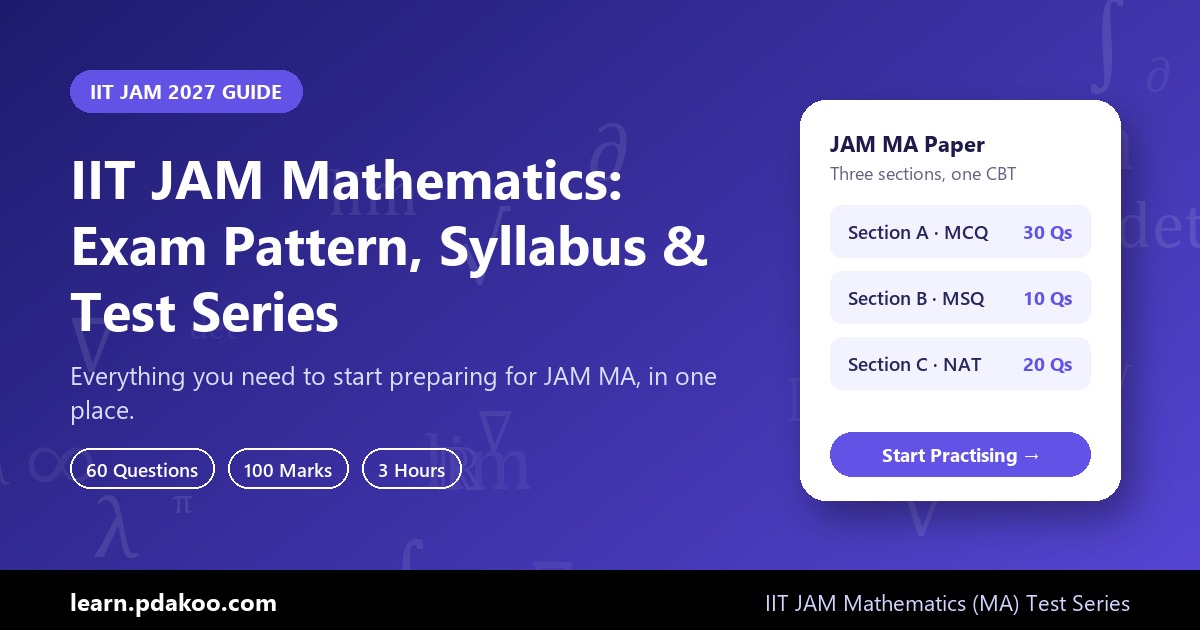
The paper has 60 questions for a total of 100 marks: 30 MCQs, 10 MSQs and 20 NAT questions, to be solved in 3 hours.
Is there negative marking in IIT JAM Mathematics?
Only in MCQs (Section A): 1/3 mark is deducted for a wrong 1-mark question and 2/3 for a wrong 2-mark question. MSQ and NAT questions have no negative marking.
Which is the most important topic for JAM Mathematics?
Real Analysis (sequences, series, functions of one and several variables and integral calculus) carries the largest share. Linear Algebra and Group Theory are the next most important.
When should I start taking mock tests?
Start subject-wise tests as soon as you finish a unit. Begin full-length mocks once you have covered the syllabus at least once, ideally 2–3 months before the exam.
Where can I practise IIT JAM Mathematics tests?


 Launch your Graphy
